
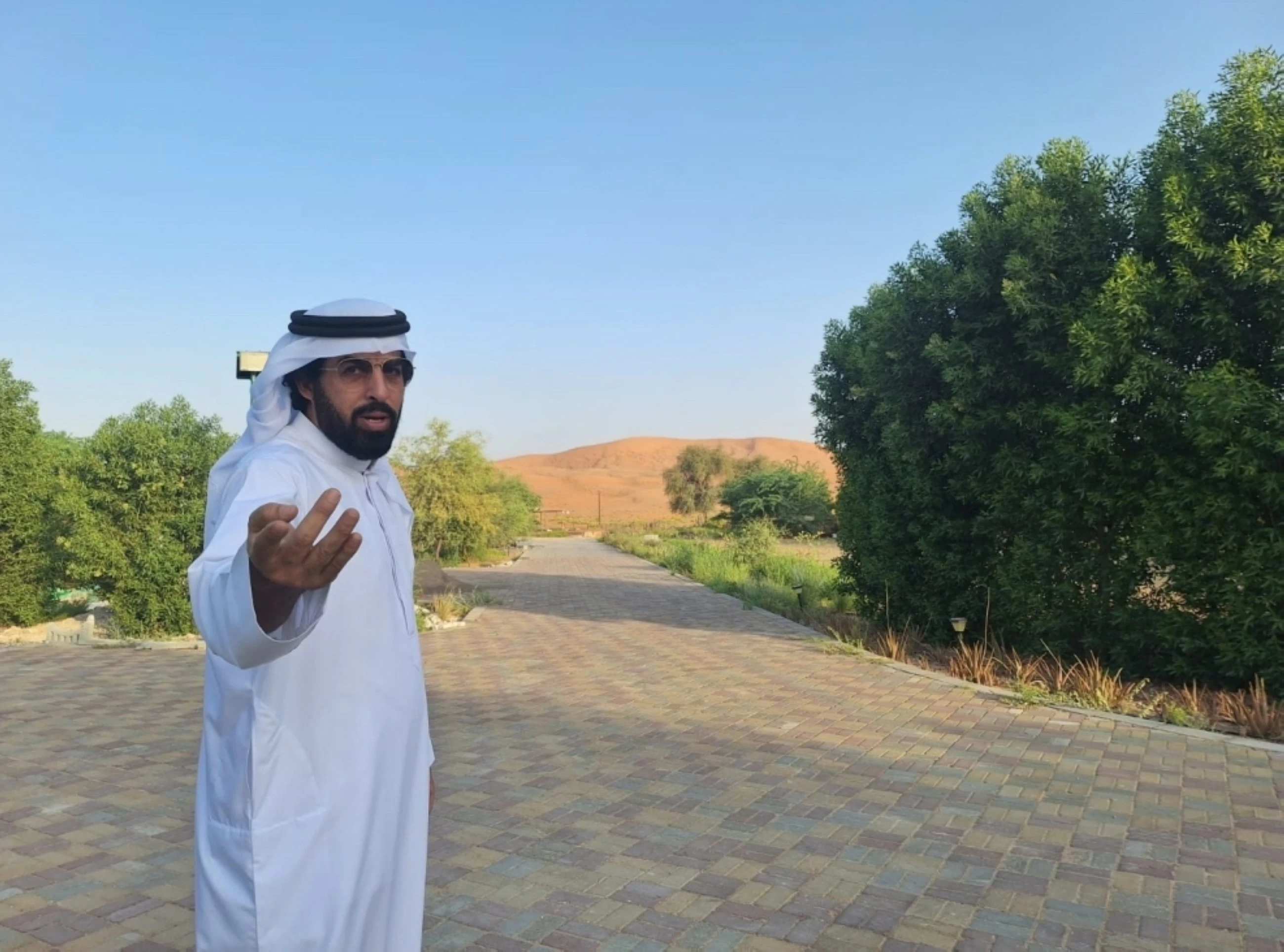
Transforming Arid Landscapes: Manea Abdullah Bin Huwaireb Al Muhairi's Agricultural Renaissance in Al Aamerah
Manea Abdullah Bin Huwaireb Al Muhairi, an enterprising Emirati and resident of Al Ain, has pioneered a remarkable agricultural metamorphosis amidst the challenging desert conditions of Al Aamerah. Through the innovative application of sustainable agriculture practices, Al Muhairi has converted his arid farmland into a flourishing oasis, successfully cultivating a variety of non-native fruit trees. His achievements underscore not only personal ambition but also broader implications for sustainability and food security in the United Arab Emirates.
Al Muhairi’s transformation began in earnest after he acquired the farm in 2007. With a background in business administration from a prestigious U.S. university, he embarked on an agricultural journey that would test both his resolve and creativity. It wasn’t until 2010 that he implemented his groundbreaking ideas—introducing over ten non-native tree species known for their exceptional fruit quality. These varieties hailed from their native territories and were meticulously grafted onto local trees capable of withstanding the unique climatic and soil conditions of the UAE.
His innovative agricultural practices turned his farm into an experimental field, yielding an impressive array of fruits, including bananas, pomegranates, grapes, numerous berry varieties, oranges, and even Egyptian sugarcane. Al Muhairi noted that the success of these initial experiments motivated him to delve deeper into agricultural innovation. He claimed, “The results at the outset inspired me to push the limits of what is possible in our region.”
This transformation relied heavily on biological methods rather than conventional fertilizers. Al Muhairi developed organic mixtures for soil treatment, emphasizing the importance of using sustainable resources. Central to his approach was the introduction of earthworms—initially a few thousand—which multiplied exponentially to millions. The worms consumed the tree waste, excreting nutrient-rich organic fertilizer that was then utilized to enhance soil fertility.
What appears to be a simple cycle in nature became a linchpin in Al Muhairi’s agricultural strategy. The organic fertilizer produced from the earthworms contained essential enzymes and beneficial bacteria, significantly amplifying soil nutrient levels. He noted, “After conducting a series of experiments, I discovered that the water produced from the earthworm basins could be used to further nourish the soil, achieving astonishing results.”
Dedicated to diversification, Al Muhairi allocated sections of his farm for cultivating balanced, non-genetically modified seeds. This initiative yielded a plethora of vegetables, notably peppers, celery, parsley, onions, and coriander. By emphasizing organic and natural practices, his farm stands as a model for sustainable agriculture in the region.
In addition to fruit and vegetable cultivation, he ventured into beekeeping, dedicating another portion of his farm to nurturing close to 18 carefully selected varieties of Sidr trees. These trees not only provide a habitat for bees but also play a critical role in producing premium Sidr honey, further diversifying his agricultural output and income streams.
Al Muhairi’s dedication to sustainability extends beyond cultivation. He has integrated a closed-loop system into his operations, where every element of the farm’s waste is repurposed. For example, wood from tree pruning is converted into wood shavings for chicken coops or utilized to create fencing and firewood. This meticulous process reflects a deep commitment to reducing waste and maximizing resource efficiency.
As food security becomes a growing concern in arid regions, Al Muhairi’s commitment to sustainable agricultural practices highlights a potential pathway forward. His efforts not only help to alleviate food scarcity but also embody a vision for environmental stewardship in the UAE. By expertly combining technology, traditional methods, and a drive for innovation, he illustrates how the desert can be transformed into a productive landscape.
Manea Abdullah Bin Huwaireb Al Muhairi’s journey encapsulates the spirit of entrepreneurship harmonized with environmental consciousness—a model for aspiring farmers across the Gulf region and beyond. In a time when the world increasingly prioritizes sustainability, his work serves as a beacon of hope and inspiration.
Tags:
#UAE #AgricultureNews #EnvironmentNews #SustainableFarming #FoodSecurity #AlAin