

The first time you prepare for Umrah, you have a lot of questions.
You watch videos, ask people who have already been, try to memorise the supplications. And the more you read, the more it can feel as if there’s an enormous amount to learn before you even reach Makkah.
Yet the sequence of Umrah is fairly simple. You enter the state of consecration, walk seven times around the Kaaba, make seven trips between Safa and Marwa, then shave or cut your hair to complete the rite. Four main steps, in that order.
The rest is preparation, recommended acts, supplications and rules of conduct around this act of devotion. Each rite has a meaning and rules worth knowing, but there’s no need to turn your first pilgrimage into a memory test.
The Saudi Ministry of Hajj and Umrah publishes an official guide that walks pilgrims through each stage in order. For the visa, Nusuk and the season dates, see our guide to Umrah from the UAE.
Umrah in four steps
- Ihram: prepare and enter the state of consecration. Make the intention for Umrah before passing the miqat for your route.
- Tawaf: walk seven times around the Kaaba. Start level with the Black Stone, keeping the Kaaba on your left.
- Sa’i: walk seven times between Safa and Marwa. Start at Safa and finish at Marwa.
- Halq or taqsir: shave or cut your hair. This completes Umrah and ends the state of ihram.
Source: Nusuk, the Umrah journey.
1. Ihram: your Umrah starts before you reach Makkah
The first thing to understand: ihram isn’t just white clothing.
It’s a state of consecration you enter with the intention of performing Umrah. From that moment, some normally permitted things are temporarily forbidden until the rites are complete.
You must enter ihram at the miqat, the religious boundary that applies to your route.
Flying from Dubai
If you take a direct flight to Jeddah intending to go to Makkah for Umrah, you must enter ihram before the plane passes the miqat.
The easiest way is to prepare before boarding: wash, change, check your belongings and make wudu if you can. Then make your intention when the crew announces the approach to the miqat, or early enough not to risk passing it. Don’t wait until you land at Jeddah.
If you go to Madinah first, the miqat for your later journey to Makkah is Dhul-Hulayfah, also called Abyar Ali.
Rules can differ for some routes or travel intentions. If in doubt, check your situation with a qualified religious guide before you leave.
What to wear
For men, the usual ihram is two pieces of unstitched cloth: one around the waist, the other over the shoulders.
For women, there’s no compulsory white outfit. They wear loose, modest, appropriate clothing. Ihram rules forbid them, among other things, a fitted face veil (niqab) and gloves; how to cover in certain situations is a matter of legal detail.
Before entering ihram, it’s recommended to perform ghusl, the full ritual bath, where possible. You can also trim your nails and get yourself ready beforehand.
The intention and the talbiyah
When entering ihram, you sincerely make the intention to perform Umrah. You can say:
لَبَّيْكَ اللَّهُمَّ عُمْرَةً
Labbayka Allahumma ‘umratan. “Here I am, O Allah, to perform Umrah.”
Then you recite the talbiyah, the supplication you hear constantly during the pilgrimage:
لَبَّيْكَ اللَّهُمَّ لَبَّيْكَ، لَبَّيْكَ لَا شَرِيكَ لَكَ لَبَّيْكَ، إِنَّ الْحَمْدَ وَالنِّعْمَةَ لَكَ وَالْمُلْكَ، لَا شَرِيكَ لَكَ
Labbayka Allahumma labbayk, labbayka la sharika laka labbayk. Innal-hamda wan-ni’mata laka wal-mulk, la sharika lak.
“Here I am at Your call, O Allah, here I am. You have no partner. All praise, blessings and sovereignty are Yours. You have no partner.”
Men usually recite it aloud, women more quietly.
During ihram, avoid perfume, cutting hair or nails, marital relations and the other acts forbidden in this state. Men also have specific clothing rules.
Once in ihram, taking off the white clothes doesn’t end it: the state lasts until the rites are complete.
2. Tawaf: seven rounds of the Kaaba
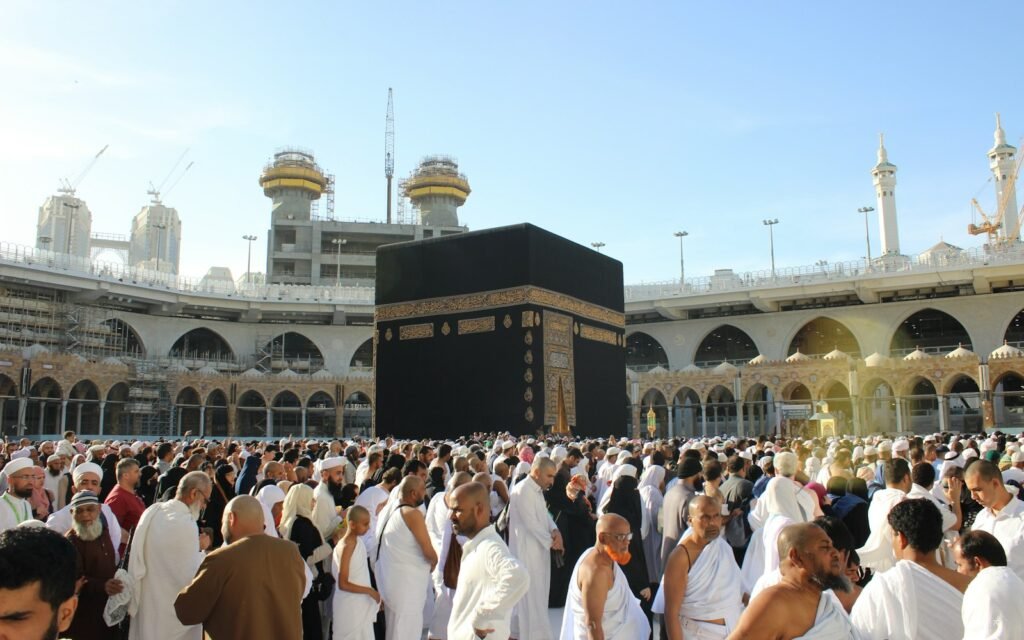
This is often the moment people look forward to most. You enter the Masjid al-Haram, see the Kaaba, and realise you’re finally standing before the place you’ve faced in prayer for years.
Take a moment, without blocking the flow. There’s no need to rush into the crowd.
Tawaf means walking seven complete rounds of the Kaaba, anticlockwise, always keeping it on your left.
How to start
Find the corner of the Kaaba with the Black Stone (Al-Hajar al-Aswad). Level with it, face it if you can without blocking others, raise your hand and say:
اللَّهُ أَكْبَرُ
Allahu Akbar. “Allah is the Greatest.”
Then start walking. When you’re back level with the Black Stone, you’ve completed your first round. Continue until you’ve counted seven.
Do you have to touch or kiss the Black Stone?
No, it isn’t a condition of tawaf. When it’s crowded, gesture with your hand and say “Allahu Akbar”.
Don’t push anyone to get closer. Other pilgrims’ safety comes before a recommended gesture.
What to recite during the seven rounds
You can call on Allah, glorify Him, recite Quran or ask forgiveness. There’s no compulsory list with a different supplication for each round.
That matters, because some booklets give the impression you must learn seven set texts and recite them in strict order. You can make personal supplications, in your own language: forgiveness, health, protection for your family, guidance, peace of heart.
Between the Yemeni corner and the Black Stone, a well-known supplication from the Sunnah is:
رَبَّنَا آتِنَا فِي الدُّنْيَا حَسَنَةً وَفِي الْآخِرَةِ حَسَنَةً وَقِنَا عَذَابَ النَّارِ
Rabbana atina fid-dunya hasanatan wa fil-akhirati hasanatan wa qina ‘adhaban-nar.
“Our Lord, give us good in this world and good in the Hereafter, and protect us from the punishment of the Fire.”
For men
Where conditions allow, men are recommended to uncover the right shoulder during the Umrah tawaf, called idtiba’, and to walk a little faster for the first three rounds, called ramal. These recommended practices never justify jostling others. After tawaf, men normally cover the shoulder again before praying.
After the seven rounds
It’s recommended to pray two units (rak’ahs), behind Maqam Ibrahim if possible. If it’s crowded, pray elsewhere in the mosque: no need to force your way close to the Maqam among the pilgrims.
You can then drink Zamzam water, rest a little, and head to Safa and Marwa.
3. Sa’i: seven trips between Safa and Marwa
After tawaf comes sa’i. The rite recalls Hajar, mother of the Prophet Ismail, who searched for water for her child in the valley of Makkah, trusting in Allah while making every effort.
Today Safa and Marwa are inside a vast covered area of the Masjid al-Haram, and the route is clearly marked.
The count to remember
This is where many first-timers go wrong. One trip from Safa to Marwa counts as one full lap. A round trip is not one lap.
| Lap | Route |
|---|---|
| 1 | Safa → Marwa |
| 2 | Marwa → Safa |
| 3 | Safa → Marwa |
| 4 | Marwa → Safa |
| 5 | Safa → Marwa |
| 6 | Marwa → Safa |
| 7 | Safa → Marwa |
So you start at Safa and finish at Marwa.
At the start, near Safa, you can recite the Quranic verse:
إِنَّ الصَّفَا وَالْمَرْوَةَ مِن شَعَائِرِ اللَّهِ
Innas-Safa wal-Marwata min sha’a’irillah. “Indeed, Safa and Marwa are among the symbols of Allah.” (Quran, Al-Baqarah, 2:158.)
On Safa and on Marwa, it’s recommended to face the qibla, glorify Allah and make supplication.
Part of the route is marked by green lights. There, men walk faster or jog lightly when possible; women keep their normal pace.
As in tawaf, personal supplications are fine. Don’t worry about not knowing long formulas by heart: it isn’t a recitation contest. Slow down when you’re tired. Elderly pilgrims, people with reduced mobility and those who find walking hard can use the assistance provided by the authorities.
4. Cutting the hair: the final act
Once the seven laps end at Marwa, one step remains: the haircut.
Men have two options: shave the whole head (halq) or shorten the hair all over (taqsir). Shaving carries particular merit in the Prophetic tradition.
Women simply cut a small length from the tips, around 1 to 2 centimetres according to Nusuk’s practical guidance. They don’t shave their heads.
You can have your hair cut after leaving the mosque, for instance in a licensed barber. But you remain in ihram until it’s done. Once it is, your Umrah is complete and the ihram restrictions end.
The Saudi ministry recommends licensed barbers, whose tools must be clean and disinfected.
How long does it take?
About two to three hours on site, on foot, with ordinary crowds, according to the indicative times in pilgrim guides. Allow considerably more in Ramadan or busy periods.
It isn’t a target. Some pilgrims take longer to walk, rest or pray; others go faster. With children, an elderly person or someone who walks with difficulty, allow more margin. What matters is performing the rites correctly, without exhausting yourself or making things harder for others.
The questions people hesitate to ask
Do you need to know all the supplications in Arabic?
No. Learn the parts specific to the rites, especially the talbiyah, but there’s no compulsory text for each round of tawaf or each lap of sa’i. You can call on Allah in your own words. To learn the supplications passed down in the Sunnah, prepare a small notebook or use a reliable guide.
Do you have to touch the Kaaba?
No. It isn’t a condition for a valid Umrah. Don’t jostle others or disrupt their tawaf to try to touch it.
Can you perform Umrah with children?
Yes. Children can take part with their parents, depending on their age and the permit and access rules. For the youngest, agree on a meeting point, bring water where allowed and plan breaks.
What if you lose count?
A discreet counter helps a lot; the official tools also include digital counters. If you’re genuinely unsure how many you’ve done, the rule commonly taught is to go with the number you’re sure of, the lower one, rather than invent an extra round. Some specific situations still call for religious advice.
Can you interrupt tawaf or sa’i?
A pause may be needed: congregational prayer, real fatigue, a health problem or crowd control. How to resume depends on the type of interruption and sometimes on the school of jurisprudence. A pause isn’t abandoning the rite. For a long interruption or serious doubt, ask a qualified religious guide on site.
What if a woman gets her period before or during Umrah?
She can enter ihram and carry out the permitted preparations, but tawaf is generally postponed until menstruation ends and she has purified, according to the majority legal view. Difficult cases, especially when the flight date doesn’t allow waiting, are subject to scholarly differences and deserve individual religious advice.
The most common mistakes
Waiting until Jeddah to enter ihram when your route requires doing it before the miqat. Counting seven round trips between Safa and Marwa, fourteen trips, instead of seven laps. Believing you must touch the Black Stone, even if it means pushing others. Treating a booklet’s supplications as obligations. Forgetting to cut your hair after sa’i and thinking Umrah is finished. And making photos a priority, to the point of losing your own focus or disturbing others.
On the practical side, check your visa, your Nusuk permit and your access to the pilgrim areas before you go to the Masjid al-Haram, and follow the mosque staff’s instructions. How to use the app is in our Nusuk app guide.
A checklist for your phone
- Before the miqat: I prepare and enter ihram with the intention of Umrah.
- I recite the talbiyah and observe the rules of ihram.
- I complete seven rounds of tawaf around the Kaaba.
- I complete seven laps between Safa and Marwa, finishing at Marwa.
- I shave or cut my hair according to the rules.
- My Umrah is complete and I have left the state of ihram.
What about Madinah?
Many pilgrims use the trip to visit Madinah, pray in the Prophet’s Mosque ﷺ and, if they get a slot, enter the Rawdah. It’s a visit of great spiritual value, but it isn’t part of the Umrah rites. You can perform Umrah without going to Madinah, or visit Madinah before or after Makkah. The Rawdah is booked separately on Nusuk, depending on availability.
What matters most isn’t on a list
It’s natural to want to get your first Umrah right. You pack, revise the supplications, check the steps again and again. But tawaf isn’t just seven laps, sa’i isn’t a distance to cover as fast as possible, and ihram isn’t just a change of clothes.
There may be crowds. You may be tired. You may get lost, or forget a supplication you repeated the whole flight. Tell the obligations apart from the recommended acts, ask for help when in doubt, and give yourself time to live each step.
May Allah accept your Umrah.
Guide prepared in November 2026. Schools of jurisprudence can differ on some details and on what is obligatory or recommended; this guide follows the general sequence described by Nusuk and does not replace personal religious advice. Sources: Nusuk, the four steps of Umrah, Nusuk, rites, miqats and services, Saudi Ministry of Hajj and Umrah, Umrah and visit guide, Saudi Press Agency, official multilingual guide, Saudi Press Agency, digital guide and counters.
Filed under