
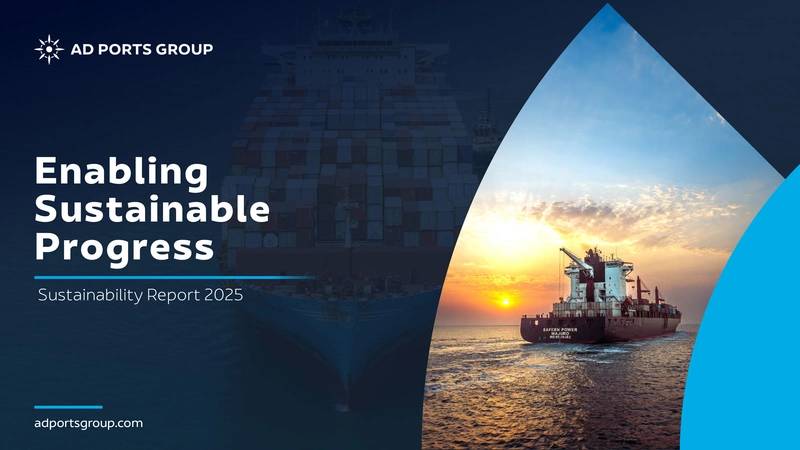
AD Ports Group Marks Significant Milestone in Sustainability Efforts Despite Increasing Emissions
In a revealing 2025 Sustainability Report, AD Ports Group, headquartered in Abu Dhabi, has reported a notable 6% reduction in emissions intensity, a metric that gauges the efficiency of emissions relative to revenue. This reduction occurs amidst a broader context where the Group’s total greenhouse gas emissions have increased by 13%, reflecting the ongoing expansion of its global ports, maritime, and logistics operations.
The emissions intensity has decreased to 190.68 tonnes of carbon dioxide equivalent (tCO2e) per AED 1 million in revenue, contrasting with last year’s figure of 203.06 tCO2e. Such a decrease in emissions intensity, while total emissions impressively rose to 3.96 million tCO2e, up from 3.51 million tCO2e the previous year, underscores the Group’s commitment to improving operational efficiencies even in a rapidly growing business environment. The company’s year-on-year revenue rose by an impressive 20%, culminating at AED 20.77 billion, indicating a strong business performance despite the challenges posed by climate considerations.
AD Ports Group attributes its advancements in emissions intensity principally to a range of initiatives aimed at enhancing operational efficiencies. Key among these efforts are the increased use of renewable electricity, the introduction of alternative marine fuels, and a concerted push towards vessel electrification. Such initiatives are not merely aspirational; they reflect a systematic approach to aligning business objectives with environmental responsibilities.
The Group’s Maritime & Shipping Cluster not only represents a significant revenue stream—accounting for 51% of total revenue—but also generates approximately 50% of the Group’s total emissions. For context, Ports contribute 24%, Logistics 21%, while Economic Cities & Free Zones account for the remaining 5%. These figures paint a clear picture of the sectors within AD Ports that necessitate targeted sustainability strategies.
In 2025, AD Ports took substantial steps to bolster its decarbonization strategy, notably through the integration of LNG-powered Pure Car and Truck Carriers operating under its United Global Ro-Ro venture. Furthermore, initiatives such as ship-to-ship LNG bunkering operations signal the company’s commitment to transitioning to cleaner energy sources within its maritime operations. The announcement of a collaborative endeavor with Nimex Terminals to establish LNG and liquefied petroleum gas terminal hubs at Khalifa Port is a further testament to AD Ports’ proactive investment in sustainable infrastructure.
Moreover, to mitigate the emissions intensity associated with electricity, heating, and cooling, AD Ports procured 47,960 MWh of renewable energy certificates, showcasing a multifaceted approach to reduce its carbon footprint across multiple operational domains.
Looking toward future sustainability endeavors, AD Ports has laid out an ambitious decarbonization roadmap consisting of 139 initiatives projected to unfold through 2050. This program, supported by an estimated 6 million investment, aims to achieve substantial cumulative emissions reductions of 2.9 million tCO2e. Key components of this roadmap include the adoption of renewable energy, transitioning the fleet to more environmentally friendly fuels, and the development of low-carbon port infrastructure—all vital for aligning with global environmental standards and expectations.
Captain Saif Al Mheiri, the CEO of Abu Dhabi Maritime and Group Chief Sustainability & Risk Officer, emphasized the strategic importance of embedding sustainability into the core of business operations. “By incorporating decarbonization into our business strategy, we are positioning the Group for enduring emissions reductions while simultaneously fortifying our operational resilience and competitive edge,” he stated.
The report also delineates advancements in waste management, revealing that AD Ports successfully diverted 10,303 tonnes of waste from disposal in 2025—a 24% increase from the 8,341 tonnes reported the previous year. Additionally, the recycling of non-hazardous waste escalated by 23% to reach 10,127 tonnes, highlighting the Group’s commitment to reducing environmental waste.
Lastly, the sustainability performance metrics have been interwoven into the fabric of corporate decision-making at AD Ports, with a portion of senior management compensation directly tied to the achievement of environmental targets. This approach not only incentivizes responsible corporate behavior but also sets a precedent for other entities in the region and beyond to follow suit in integrating sustainability into their operational ethos.
As AD Ports moves forward, it remains to be seen how these efforts will contribute to broader environmental objectives, but the initial strides show promise for a company dedicated to harmonizing business growth with ecological responsibility.
Tags: #BusinessNews, #EconomyNews, #UAE, #Sustainability, #MaritimeEnvironment