
Tahnoun International Airport Sees Significant Growth Amidst Expanding Connectivity
Al Ain, UAE – As the aviation sector continues its recovery from the challenges posed by recent global events, Tahnoun International Airport (AAN), formerly known as Al Ain International Airport, has demonstrated remarkable resilience and growth. Renamed in honor of the late Sheikh Tahnoun bin Mohammed Al Nahyan, the airport has recently reported a substantial upsurge in aircraft movements, marking a pivotal moment in its operational history.
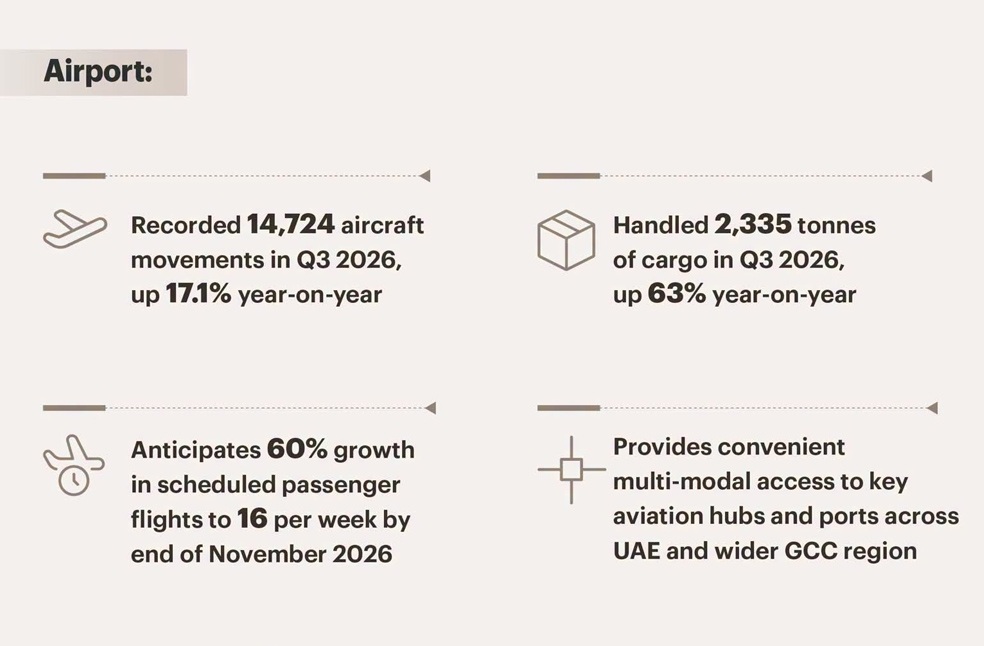
In the third quarter of 2026, Tahnoun International Airport recorded 14,724 aircraft movements, reflecting a commendable increase of 17.1 percent compared to the same period in the previous year. This recovery is not an isolated occurrence; throughout the first nine months of 2026, total aircraft movements reached an impressive 48,558, representing a 17.9 percent year-on-year increase. Such figures are indicative of the airport’s strategic importance and the resurgence of travel demand in the region, aligning with broader trends observed across the Gulf Cooperation Council (GCC) nations.
The cargo sector has been equally impressive, illustrating AAN’s role as a vital logistics hub. Between July and September 2026, the airport handled 2,335 tons of cargo—a staggering increase of 63 percent from the same quarter in 2025. By the end of September, total cargo volume for 2026 soared to 7,335 tons, achieving a remarkable year-on-year growth of 110.4 percent. This surge in cargo operations highlights Tahnoun International Airport’s growing significance for trade, particularly in a region known for its robust logistics capabilities.
Passenger connectivity is poised for improvement as well, with projections indicating that the scheduled flight frequencies will expand to 16 services per week by the end of November 2026. This marks a significant 60 percent increase and promises to enhance travel options for locals and visitors alike.
Central to AAN’s expansion is its strategic location, which offers seamless multimodal connections to major aviation hubs as well as seaports throughout the United Arab Emirates (UAE) and the broader GCC region. Specifically, the airport enjoys proximity to Zayed International Airport—just a 1.5-hour drive away—and is situated near an impressive 5 million square meters of serviced free zone land. These facilities are designed to accommodate businesses eager to tap into the expanding network of air, maritime, and rail connections.
Looking ahead, Tahnoun International Airport’s connectivity is expected to receive a further boost with the anticipated completion of the Hafeet Rail project by 2028. This railway initiative will create a direct link between AAN and the UAE’s Etihad Rail network, as well as connect to Sohar Port in Oman, laying the groundwork for enhanced regional transport and trade interactions. Such developments reinforce Al Ain’s potential as a critical node in regional trade routes.
Ahmed Juma Al Shamisi, the CEO of Abu Dhabi Airports, remarked on the significance of these growth metrics. “The growth we are seeing at Tahnoun International Airport (AAN) reflects the strength of its location and the role it plays in connecting Al Ain to the UAE and the wider GCC region,” he stated. Al Shamisi added, “With convenient access to the country’s major aviation hubs and ports, and Hafeet Rail set to link the airport to the Etihad Rail network and Sohar Port, AAN is well positioned to support the continued growth of trade and travel through Al Ain.”
The promising trajectory of Tahnoun International Airport is indicative of a larger narrative within the UAE’s aviation landscape, one characterized by resilience, innovation, and ambition. As the airport enhances its operational capabilities and expands its connectivity, it stands to strengthen Al Ain’s position as a regional hub for trade, travel, and logistics, reflecting the UAE’s ongoing commitment to diversifying its economy and enhancing its global connectivity.
With such significant advancements, Tahnoun International Airport not only exemplifies the future of air travel and logistics within the UAE but also serves as a beacon of progress in the Gulf region, paving the way for strengthened economic ties and enhanced opportunities for businesses and travelers alike.
Tags: #UAE #BusinessNews #EconomyNews