
UAE Emerges as a Dominant Source of International Capital Amid Saudi Arabia's Investment Shift
In recent years, the United Arab Emirates (UAE) has emerged as a prominent player in the global investment landscape, significantly amplifying its outward investment activities. A report released by McKinsey & Co. highlights this trend, suggesting that the UAE’s proactive approach to international capital deployment has solidified its role as a vital source of funding at a time when Saudi Arabia, traditionally a leader in this domain, has experienced a deceleration in its petrodollar inflows.
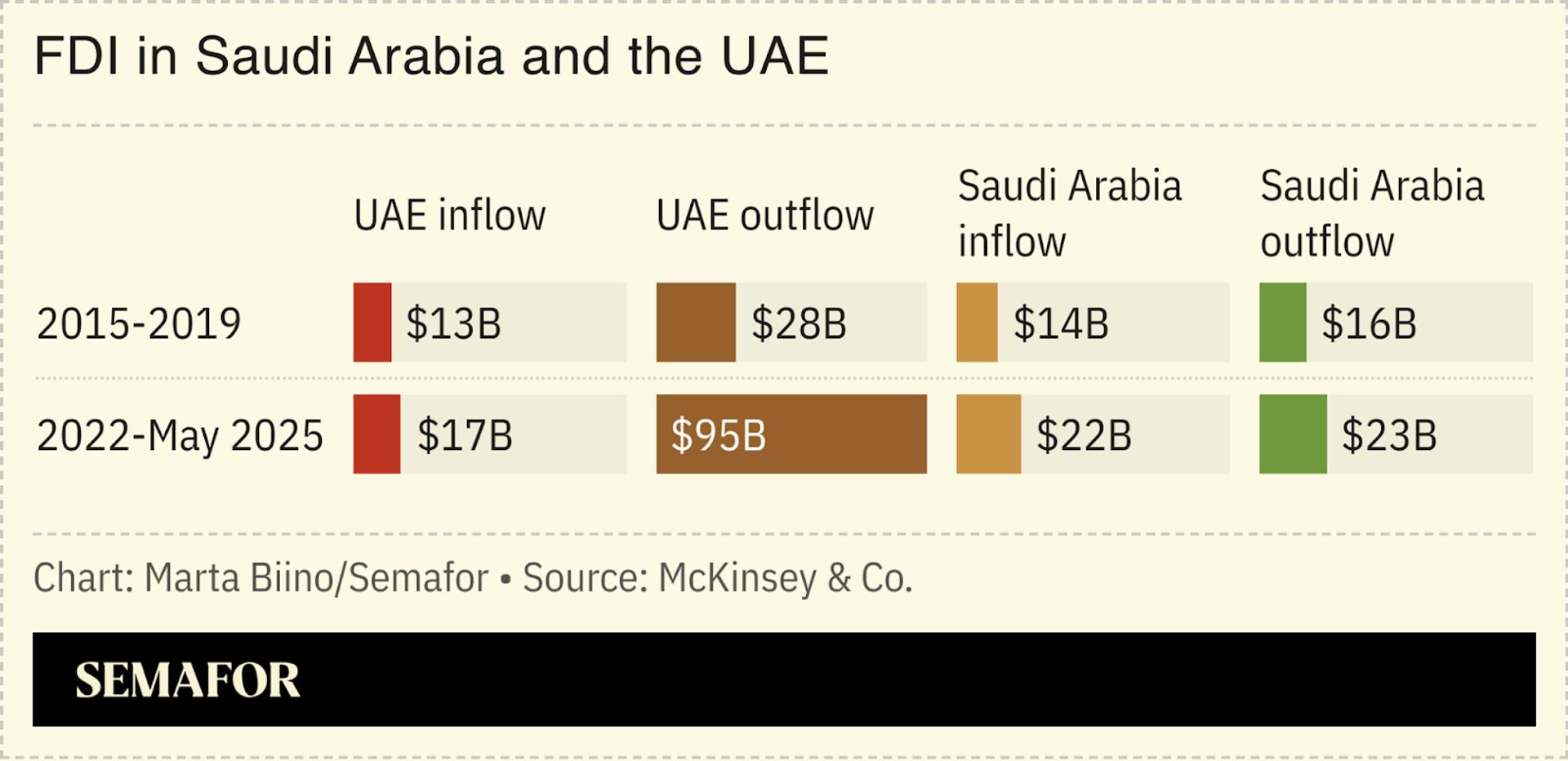
The dynamics of foreign direct investment (FDI) reflect a dramatic shift in the financial flows within the Gulf Cooperation Council (GCC). Between 2022 and May of the current year, FDI inflows into Saudi Arabia surged by an impressive 60%. However, the Kingdom’s outward investment increased only by 46%, marking a significant departure from its historical pattern of capital exportation. As a result, Saudi Arabia now finds itself in a position where it attracts more foreign investment than it repatriates, a critical pivot for a nation historically reliant on oil revenues.
This alteration in capital flows is particularly pertinent against the backdrop of Crown Prince Mohammed Bin Salman’s ambitious economic transformation initiatives, aimed at diversifying the Saudi economy beyond hydrocarbons. While the influx of foreign investment is undoubtedly a boon for these reforms, the diminished outward investments signal potential challenges for entities that have come to depend on the recycling of Saudi oil revenues through international markets.
Conversely, the UAE has aggressively expanded its outward investment portfolio, showcasing a strategic pivot towards establishing itself as a leading global investor. Data indicates that UAE’s foreign direct investment outflows more than tripled, climbing to an astonishing billion, while inward FDI lagged behind at billion. This striking disparity underscores the UAE’s resolve to position itself not only as a regional investment hub but also as a crucial player in the global economic arena.
Several factors contribute to this increasing capital export by the UAE. First, the country’s robust economic framework, characterized by a diversified economy with strong sectors in tourism, finance, and technology, provides a solid foundation for investors. The UAE has cultivated a favorable business environment, marked by cutting-edge infrastructure, low corporate taxes, and a commitment to innovation, thus creating an ecosystem ripe for investment.
Additionally, the UAE’s strategic geographic location between Europe, Asia, and Africa enhances its appeal as a central hub for global investment flows. The country serves as a gateway for Asian companies looking to enter western markets and vice versa, thereby facilitating cross-border investment opportunities that are advantageous for both local and foreign investors.
Furthermore, the UAE has actively sought to build international partnerships, notably through initiatives such as the Abraham Accords, which have opened pathways for collaboration with Israel and other nations. These diplomatic advances complement the UAE’s investment ambitions by fostering an environment conducive to trade and long-term economic cooperation.
The contrast in investment behaviors between the UAE and Saudi Arabia may also have broader implications for the regional economy and geopolitical landscape. The UAE’s ascent as an investment powerhouse may prompt neighboring nations to recalibrate their strategies to retain competitiveness. As GCC countries increasingly vie for foreign capital, the regional dynamics may evolve, with different nations pursuing diverse pathways to economic growth.
In conclusion, the transformation of the UAE into a leading source of international capital can be seen as part of a larger narrative of shifting economic paradigms within the Gulf region. As Saudi Arabia grapples with its altered investment landscape, characterized by increasing internal capital attraction, the UAE’s commitment to enhancing outward investment underscores its ambition to thrive in an interconnected global economy. Going forward, the interplay of these forces will likely shape the future of investment strategies across the GCC, with lasting implications for the region’s economic trajectory.
Tags: #EconomyNews #BusinessNews #UAE #Saudi #CommunitiesNews