
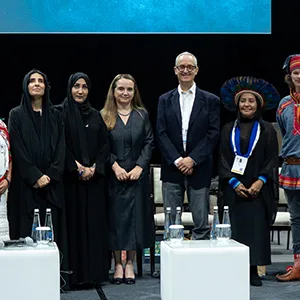
The World Summit of Indigenous Peoples and Nature, a significant milestone in the annals of global environmental discourse, took place recently in Abu Dhabi, marking a historic convergence of Indigenous leaders from across the globe. This summit was held under the auspices of the International Union for Conservation of Nature (IUCN), at the IUCN World Conservation Congress—a gathering that has now reached its 77th year.
This unprecedented event attracted nearly 200 representatives from Indigenous communities, alongside a range of stakeholders including governmental bodies, international organizations, and philanthropic entities. The primary goal of the summit was to emphasize and enhance the role of Indigenous Peoples in shaping critical climate action and biodiversity policies worldwide. Sustainable development and conservation strategies have been increasingly recognizing the essential contributions of Indigenous communities, who are guardians of more than 80 percent of the planet’s biodiversity.
The summit was coordinated by IUCN and hosted by the Environment Agency – Abu Dhabi (EAD). It provided a unique platform to integrate traditional ecological knowledge with contemporary scientific insights, an endeavor that directly aligns with ambitious global goals such as the Kunming-Montreal Global Biodiversity Framework and the Paris Agreement on Climate Change. The integration of Indigenous wisdom into global conservation strategies may represent a transformative step toward more holistic approaches to environmental stewardship.
In a groundbreaking move, this summit served as the first occasion where all Indigenous member organizations of the IUCN convened physically to establish shared priorities for environmental management and conservation. An emblematic feature of the event was the inauguration of the Indigenous Peoples Pavilion at the IUCN Congress exhibition—a dedicated space that represented a fusion of knowledge, culture, and science, fostering a new focal point for conservation discussions throughout the week.
Eminent figures gave voice to the significance of this event during the opening ceremony. Notable attendees included Her Excellency Dr. Shaikha Salem Al Dhaheri, Secretary General of EAD; Her Excellency Razan Khalifa Al Mubarak, President of IUCN; and Dr. Grethel Aguilar, Director General of IUCN. They were joined by Indigenous leaders and representatives from various countries, including Brazil and Canada, enhancing the summit’s international character.
Elaina Cox, a notable advocate for the integration of Traditional Knowledge in decision-making, poignantly noted the historic nature of the summit, emphasizing the previously limited involvement of Indigenous Peoples in high-level conversations on biodiversity frameworks. Her reflections highlight a growing awareness within the global community that valuing Indigenous perspectives is essential for authentic progress toward sustainable environmental policies.
Dr. Shaikha Salem Al Dhaheri, reflecting on the summit’s impact, stated that it underscores the potential of listening to Indigenous voices—those who have safeguarded the world’s most diverse ecosystems for generations. She expressed her pride in the UAE’s role as a host for this pivotal gathering, which celebrates the intersection of traditional and scientific knowledge.
Razan Khalifa Al Mubarak further articulated the intrinsic relationship between Indigenous identities and the natural environment. She argued that, for Indigenous Peoples, nature transcends mere economic utility; it encompasses their very sense of identity, culture, and belonging. The summit, she declared, is not merely a notable event—it’s a transformative step toward integrating Indigenous knowledge at the core of conservation initiatives globally.
In addition to formal discussions, Indigenous leaders participated in a Knowledge Exchange in the enchanting Abu Dhabi desert, designed to foster informal dialogues about traditional knowledge systems. This cultural exchange, enriched by storytelling and discussions about various forms of coexistence with nature, emphasized shared approaches to conservation and resource management across a spectrum of global ecosystems.
The outcomes of this summit are expected to feed into the development of the IUCN’s 2026-2029 Programme, reinforcing the connection between global biodiversity, climate initiatives, and sustainable development objectives. Through collaboration and respect for Indigenous knowledge systems, there is hope for a more robust and effective global conservation framework that honors the voices of those who have long understood humanity’s relationship with nature.
This momentous gathering serves as a reminder of the pivotal role Indigenous communities can and should play in navigating the complex landscape of climate change and biodiversity loss. By embracing their insights and experiences, the global community pulls itself closer to crafting solutions that honor both the planet and its original custodians.
Tags: #UAE #EconomyNews #EnvironmentNews