
—
The Shifting Landscape of AI Adoption in the UAE: Insights from Red Hat's Recent Survey
In advancing its status as a regional technological hub, the United Arab Emirates (UAE) is witnessing a substantial inclination toward artificial intelligence (AI) within its organizational IT strategies. A recent survey conducted by Red Hat highlights this trend, revealing that UAE organizations plan to increase their AI investment by an average of 31% by the end of 2026. This ambitious target underscores the growing recognition of AI as a pivotal tool for driving business transformation and enhancing operational efficiency.
When queried about their IT strategies for the upcoming year and a half, an overwhelming 82% of respondents identified AI as a primary focus area. This is closely followed by concerns regarding security (83%), cost optimization (81%), and considerations of sovereignty (76%). These priorities reflect a comprehensive approach to integrating advanced technologies while ensuring the safeguarding of organizational integrity and financial prudence.
Nevertheless, despite this optimistic outlook on AI investment, a significant disparity emerges between intention and execution. Alarmingly, 96% of the organizations surveyed reported that they have yet to realize substantial customer value from their AI initiatives. The realization of AI’s potential remains a tantalizing challenge, leading many organizations to seek ways to translate their technological ambitions into tangible outcomes.
One burgeoning approach to overcoming these hurdles involves a growing reliance on open-source technologies. Remarkably, 100% of UAE IT leaders perceive open source as essential in achieving objectives related to cost optimization, the evolution of post-quantum cryptography, and enhancing virtualization capabilities. By adopting open-source models, organizations can leverage community-driven solutions that not only reduce operational costs but also foster innovation and collaboration.
Embracing the Future of AI: Priorities and Challenges
As organizations outline their evolving relationship with AI, several specific areas are emerging as critical priorities. Notably, 83% of respondents indicated that developing agentic AI—systems able to operate autonomously and perform complex tasks with minimal human oversight—is among their top objectives. In tandem, fostering employee engagement and effectively operationalizing AI were also identified as significant challenges, with 86% and 85% of respondents, respectively, emphasizing their importance.
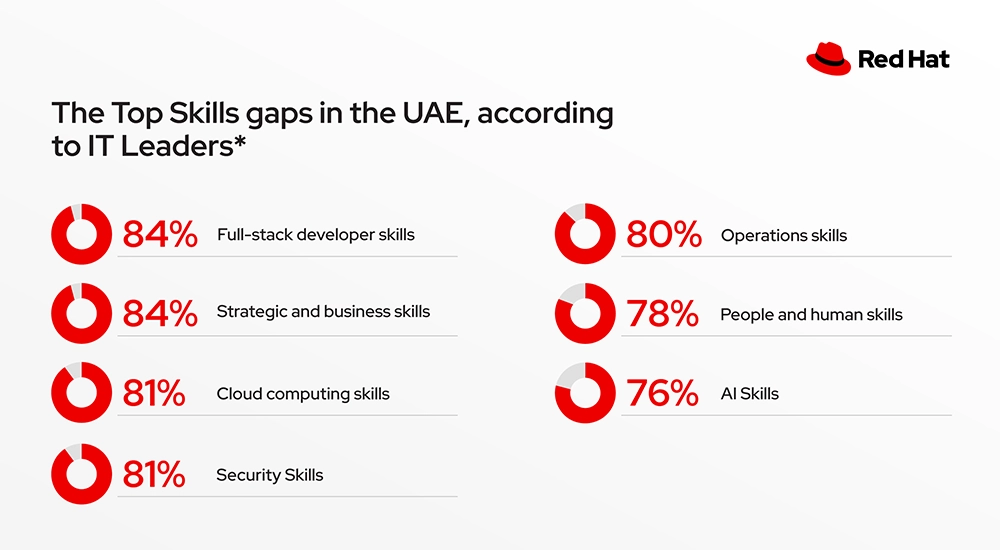
Despite this enthusiasm, the survey highlighted a pressing issue: a demonstrable talent gap in the field of AI. A notable 76% of respondents pinpointed a lack of skilled personnel as a critical impediment to further AI adoption. This talent gap correlates closely with the top strategic priorities among UAE IT leaders, emphasizing the need for a workforce adept at connecting AI systems to enterprise data, utilizing agentic AI effectively, and educating business units on how to harness AI tools.
Moreover, nearly all respondents (98%) reported encountering barriers that hinder AI adoption, which predominantly include integration challenges with existing systems (36%), concerns regarding data privacy and security (32%), and insufficient stakeholder buy-in (32%). Many organizations also reported grappling with the phenomenon of “shadow AI,” where employees utilize unauthorized AI tools, further complicating governance and compliance.
The Road Ahead: Optimism Confronts Constraints
Despite these challenges, there remains a robust belief among UAE enterprises regarding the nation’s trajectory in AI development. A stunning 99% of respondents are confident that the UAE will emerge as a prominent AI powerhouse within the next three years. This optimism mirrors sentiments in other European nations, notably Spain, Sweden, Germany, and the Netherlands, where vast majorities share a similar confidence regarding their respective AI advancements.
However, turning this optimism into reality is hindered by several constraints. More than 60% of respondents cited a lack of computing infrastructure as a significant limitation, followed closely by an inadequate talent pipeline (52%) and insufficient public funding (45%). These challenges, compounded by national priorities around data protection and sovereignty, add further complexity to the already intricate landscape of AI integration into business strategies.
Organizations are also focusing on cloud sovereignty, where operational control and autonomy, security of the software supply chain, and supplier flexibility are anticipated as key areas of interest over the next 18 months. Still, challenges persist, with leadership support (77%), unclear return on investment (72%), and employee resistance to change (69%) consistently identified as barriers limiting the effective deployment of cloud technologies.
As the UAE navigates these multifaceted challenges, the journey toward becoming a global leader in AI remains a work in progress. Nonetheless, the concerted efforts to embrace open-source strategies and enhance workforce skills will undoubtedly play a crucial role in shaping the future of technology and business in the region.
—
Tags: #UAE #BusinessNews #EconomyNews